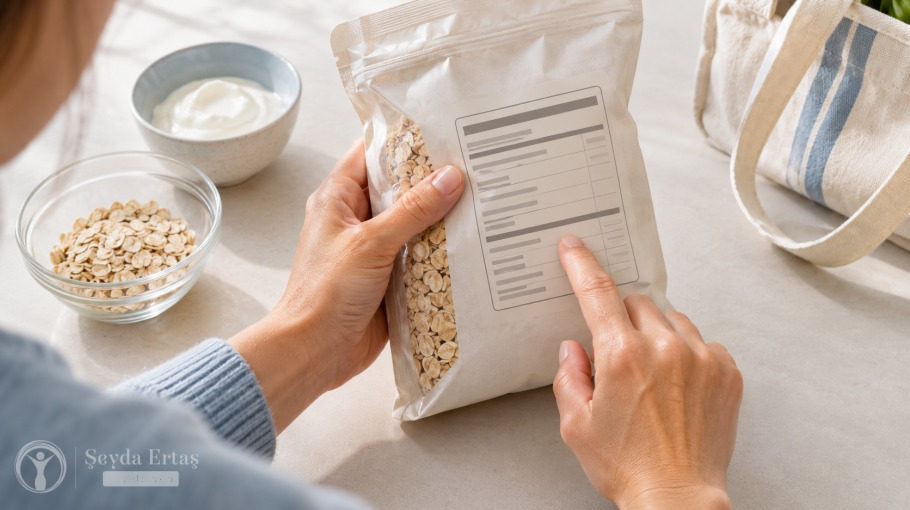
One pack says “high protein”; another says “no added sugar.” Neither phrase tells you everything you need to choose between them. Turn the packs over and read the amount, nutrition panel and ingredients together. Lower sugar does not automatically mean fewer calories or less salt.
Start with three questions: are the figures per 100 g or per serving, how much will you eat, and are you comparing similar foods in equal amounts? Those checks make the numbers useful. [1]
Serving size is not necessarily your portion
On a US Nutrition Facts label, “serving size” gives the amount used for the figures and “servings per container” tells you how many such servings are in the pack. A labeled serving is not an individual eating recommendation. A package may contain more than one. [2]
Many UK and Turkish nutrition tables also give values per 100 g or 100 ml. That column helps you compare products on an equal basis; calculate your portion separately. For an invented example with 400 kcal per 100 g, a 40 g amount provides 400 × 40 / 100 = 160 kcal. The entire 120 g pack provides 480 kcal. The 40 g amount is a calculation example, not a portion prescription.
Apply the same multiplier to protein, sugars or salt. If the panel uses 100 ml, use the volume you drink rather than assuming grams and milliliters are interchangeable. Calories and kilojoules are also different units for the same energy: the kcal and kJ explanation shows why you should not add them together.
A worked comparison of two cracker labels
These two labels are fictional teaching examples. They do not represent brands, market averages or product recommendations. Every row compares the same 100 g amount.
| Example nutrition panel, per 100 g | Cracker A | Cracker B |
|---|---|---|
| Energy | 400 kcal | 400 kcal |
| Fat / saturated fat | 12 g / 3 g | 14 g / 2 g |
| Carbohydrate / sugars | 59 g / 10 g | 58 g / 5 g |
| Fiber | 8 g | 5 g |
| Protein | 10 g | 8 g |
| Salt | 1 g | 1.6 g |
The calories match. B contains less sugar but more salt and less fiber. A contains less total fat but more saturated fat. Choosing “the lower-sugar one” does not resolve every difference; priorities depend on the rest of your meals and any individual nutrition advice.
At 40 g each, both provide 160 kcal. A supplies 4 g sugars, 3.2 g fiber and 0.4 g salt; B supplies 2 g sugars, 2 g fiber and 0.64 g salt. If you eat 40 g of A but 60 g of B, the latter contributes 240 kcal. Separate the difference between products from the difference between portions.
Would you like to receive professional diet counseling?
Yes, I DoTotal carbohydrate, total sugars and added sugars
Sugars are included in carbohydrate. Do not add A's 10 g of sugars to its 59 g of carbohydrate. Total sugars can include both naturally occurring and added sugars; the total alone cannot tell you how much was added. [3] [4]
On US labels, “includes … g added sugars” identifies an amount already within total sugars. The whole-milk fruit kefir example contains 18 g total sugars, including 8 g added sugars, per 240 ml. The total is not 26 g. Those figures describe that particular product, not every fruit kefir.
“No added sugar” does not mean that ingredients contain no naturally occurring sugar. “Sugar-free” does not make serving size or energy irrelevant either. For products made with sweeteners or sugar alcohols, the sweetener label guide explains how to consider carbohydrate and energy alongside the claim.
How to compare sodium with salt
US panels usually list sodium in milligrams, whereas other labels may give salt in grams. For an equal amount of food, use salt (g) = sodium (mg) × 2.5 / 1,000. For example, 400 mg sodium is equivalent to about 1 g salt. Comparing milligrams directly with grams gives the wrong result. [5]
A sea-salt percentage in the ingredient list describes an ingredient's share of the recipe, not the same information as total salt in the nutrition panel. The sea-salt dark chocolate example explains the distinction and shows how a weighed portion changes the amount consumed.
What does the ingredient list add?
The nutrition panel gives amounts of nutrients; the ingredient list tells you what went into the product. Ingredients are generally listed in descending order by weight. That order gives context, but without a stated percentage you cannot work out an exact ingredient weight from its position alone. [6]
An “oat” description does not establish that the whole pack is oats. Check the percentage if provided and read the other ingredients. Similarly, compare actual protein in the amount you will eat rather than relying on a front-of-pack claim. Consider the food's place in a meal too: a package is not automatically a complete meal.
If you have a food allergy, suitability comes before calorie comparison. The guide to allergen labels and cross-contact warnings addresses that separate check. A “plant-based” or “vegan” statement should not replace checking for your own allergens.
Personalized online diet program. Start now!
Book OnlineDoes the panel describe dry or prepared food?
Soup mixes, puddings, cereals and instant noodles can be labeled on different preparation bases. “Per 100 g prepared” is not interchangeable with “per 100 g dry.” Added water increases weight; milk or oil also changes nutrients. Check which additions the preparation instructions and panel already include.
The chicken-flavored noodle example distinguishes a 70 g dry packet from the bowl prepared with water. Multiplying the prepared-food value by the dry packet's weight gives the wrong answer. Nor can the amount of salt remaining after draining be established from dry packet weight alone.
Using % Daily Value on a US label
The percentage shows how much a serving contributes to a reference daily amount. FDA's general reading guide treats 5% DV or less as low and 20% DV or more as high. These are US label-reading aids, not your personal nutrient prescription or universal thresholds for every country's label. [7]
A practical order for reading a pack
First establish what the product is and whether it is suitable for you. Compare similar foods using equal amounts, then consider calories alongside sugars, saturated fat, sodium or salt, protein and any fiber value provided. Finally, calculate the amount you expect to eat.
You do not need to perform a full calculation for every item on every shopping trip. Start with two products you buy often. At home, measure your usual portion once and compare it with the label's serving. Notice how many portions the pack actually provides in your household. That gives you something more concrete than the claim on the front.
Turn label information into everyday food choices
A product choice makes more sense when you know what you will eat with it and how much suits your day. We can plan those decisions around your meals.