

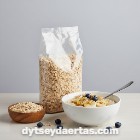
Calories in Doğalsan oat flakes
The referenced 400 g Doğalsan oat flakes panel describes dry oats at 359 calories per 100 g. A weighed 40 g portion provides 144 calories, 23.44 g carbohydrate, 4.88 g protein and 2.6 g fat. Milk, yogurt and fruit toppings are not included.
Choosing 30, 40 or 50 g
A 30 g dry portion supplies 108 calories. At 50 g, that becomes 180 calories and 6.1 g protein. The 400 g pack divides into ten 40 g portions or eight 50 g portions. These examples help plan the pack; they do not prescribe one breakfast size for everyone.
For a bowl with yogurt and fruit, weigh the dry oats first and count each addition by its own amount. Nuts, honey or peanut butter also change the total. The oats' 144 calories should not be recorded as the energy of the entire assembled bowl. Adding 10 g Doğalsan wheat germ contributes about 34 calories, 2.27 g protein and 2.2 g fibre. That addition can be calculated, while a complete bowl fibre total remains unknown because this oat label does not report fibre.
Does cooking with water reduce calories?
Water adds weight and volume without removing the oats' original energy. If you prepare 40 g dry oats using only water and eat the whole batch, the oats still contribute 144 calories. Calories per 100 g of finished porridge depend on how much water remains, so there is no single dry-to-cooked multiplier for every preparation.
Milk adds its own energy, protein and other nutrients. When sharing a cooked batch, calculate the ingredients for the whole saucepan and divide it into equal portions. A bowl of thick porridge cannot be assumed equivalent to yesterday's more watery bowl simply because their volumes match. The warm-porridge example using 40 g oats covers water or milk, cooking consistency, and the fruit or nuts added afterwards.
As a mixed-unit example, 40 g dry flakes with 100 ml Danone PRO cocoa milk provides about 200 kcal and 10.98 g protein. The unverified weight of the milk prevents calling it a 140 g bowl. With plain PRO yogurt, 180 g yogurt plus 40 g flakes totals 220 g, about 275 kcal and 21.08 g protein. Follow the oats’ preparation instructions.
Fiber, sugars and gluten
The supplier reports 1.2 g sugars per 100 g, or 0.48 g in 40 g oats. Fiber is not stated in this panel. That does not mean the oats are fiber-free; it means a verified numerical fiber value for this particular product is unavailable. A generic oat value has not been copied into the brand's table.
The 400 g supplier listing carries a gluten warning, so the product is not treated as certified gluten-free. Oat bran is a separate product too. Follow the pack's preparation and storage instructions. A mixture made with milk or yogurt should not be stored at room temperature like the dry oats.
Doğa 500 g oat flakes are a different product from the Doğalsan 400 g pack. The reviewed Doğa label gives about 155 kcal, 5.2 g protein and 3.6 g fibre per 40 g dry oats. Similar brand names do not fill the unreported fibre line for Doğalsan.
Fellas oats labeled gluten-free are a separate product example. Read trace-allergen warnings as well as gluten suitability, using the information on your own pack.


