Honey calories start with the weight of the spoonful
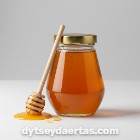
Honey provides 304 calories per 100 grams in this reference. A tablespoon weighing 21 grams supplies 64 calories. Botanical variety and brand can give different figures, so use your product label when available. This generic entry does not describe honeycomb weighed together with its wax.
Carob blossom honey provides a label example: Dahabi declares 32 kcal per 10 g. This bee-produced honey is distinct from fruit syrup sometimes sold under a similar name.
Calories in a teaspoon, tablespoon or three spoonfuls
One third of the source tablespoon is 7 grams, giving 21 calories. It is a small-spoon calculation, not a guarantee about every household teaspoon. A weighed 10-gram spoonful has 30 calories, and 15 grams has 46.
Three tablespoons weighing 21 grams each total 63 grams and 192 calories. A heaped spoon and a level spoon can differ substantially. Weigh your usual amount once, particularly if you add honey to several drinks during the day. A 7 g Katla Balla Yayla Flower Honey sachet provides about 21 calories using its fixed package weight; that does not establish the size of a household spoonful.
Weigh honey and kaymak separately: 10 g honey with 10 g Eker kaymak provides about 85 calories, with 30.4 from honey and 54.9 from kaymak. Bread is outside that total.
Is honey mainly carbohydrate, and is it better than sugar?
Per 100 grams, honey supplies 82.4 grams of carbohydrate and 0.3 grams of protein and 0 grams of fat. Total sugars in the source are 82.12 grams. Honey is not a practical way to meet protein or mineral needs.
Its water content means that calories per gram differ from granulated white sugar. A spoonful of honey can also weigh more than a spoonful of sugar, so comparing spoon counts alone is misleading. WHO includes the sugars naturally present in honey among free sugars. Neither “natural” nor “raw” removes them. WHO explanation of free sugars
The honey-sweetened pumpkin seed cookies illustrate this distinction: they contain honey and raisins even without white sugar, and their total sugars have not been verified.
Can you eat honey while trying to lose weight?
A small amount can fit if you enjoy it. There is no need to eat a daily spoonful for health. Milk, yogurt, butter and other ingredients retain their own energy when honey is added; count the whole combination. A bitter-melon mixture with honey likewise needs more than the raw fruit’s calorie figure. Honey does not guarantee a steadier blood glucose response when paired with dairy.
The same applies to sweetened tea. The guide to adding honey to linden tea shows why additions are recorded separately from a plain drink. Include honey in carbohydrate counting if you have diabetes.
In the chocolate biscuit-ball recipe, honey is counted within the mixture alongside biscuits and milk. Adding that honey again when logging a finished ball would count the same ingredient twice.
Adding 5 g honey to 200 g brewed green tea gives about 17 kcal using the selected references. Weighing the honey avoids assuming that every small spoonful contains the same amount.
Why is honey unsuitable for babies?
Do not give honey to a child younger than twelve months because of the risk of infant botulism. Mixing it into water, milk, formula or food does not change that advice. There is no suitable “small spoonful” to recommend at this age. CDC infant feeding guidance
Nutrition calculation: USDA SR28 historical reference. Variety, production and product labels may give different values. USDA SR28