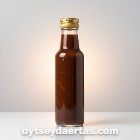
Kühne pomegranate molasses: calories from the label
The manufacturer's 100-gram panel gives 272 calories for Kühne 100% pomegranate molasses. Its ingredient is concentrated pomegranate juice. Pomegranate-flavoured sauces, sweetened syrups and molasses from sugar production are different products and do not share this calculation.
Dimes Sıkma pomegranate juice, intended as a drink, declares 58 kcal per 100 ml. Sharing the fruit name does not make it the same preparation or measurement as molasses; concentrated salad dressing cannot be calculated as a glass of juice.
Measure grams rather than assuming a spoon weight
A weighed 10 grams supplies 27 calories; 15 grams supplies 41, and 20 grams supplies 54. Spoon filling and product density affect the amount. No fixed tablespoon weight is assumed here, and a 250 ml bottle is not necessarily 250 grams. Weigh what you add to a salad for a more useful calculation.
No added sugar still contains sugar
The manufacturer describes the product as having no added sugar, while reporting 57 grams of sugar and 67 grams of carbohydrate per 100 grams. A 10-gram amount therefore contains 5.7 grams of sugar; 15 grams contains 8.55 grams. Small additions still count in a carbohydrate or calorie plan. The label cannot predict an individual's blood-glucose response, provide a glycaemic index or establish a therapeutic benefit. The guide to reading sugars, carbohydrate and energy together explains how a no-added-sugar claim fits into portion calculations.
Using its tart, sweet flavour
Start with a small amount in salads or bulgur dishes and adjust to taste. Count oil separately if it is part of the dressing. A spoonful is not equivalent to a serving of whole fruit: both the food structure and amount differ. Follow your bottle's instructions for storage after opening and its use-by guidance. Vitamins and minerals that the manufacturer does not report remain unspecified.
When changing the dressing in arugula salad with walnuts and tulum cheese, weigh pomegranate molasses and olive oil separately. The salad reference with balsamic vinegar should not be treated as including an unspecified extra amount of pomegranate molasses.
Tamarind pulp used for tart-sweet flavour is different from concentrated pomegranate juice. A 10 g edible amount contains about 3.88 g sugars, versus 5.7 g for the same weight of this molasses; the ingredients should not be treated as automatic recipe equivalents.