

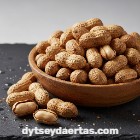
Roasted peanut calories follow the weight of the kernels
Dry-roasted unsalted peanuts provide 587 calories per 100 g. This reference excludes the hard shells. Use the package label for oil-roasted, coated or sweetened products. Raw peanuts and peanut butter need their own entries rather than this roasted-kernel record. [1]
How many calories are in a handful or ten peanuts?
A handful weighing 30 g provides 176 calories; 45 g provides 264. A handful is not a fixed weight, so weighing your usual amount once helps. The reference lists about 1 g for one kernel. Ten kernels of that size weigh 10 g and provide 59 calories. A shell can contain several kernels; counting shells and counting edible pieces are different measurements.
How much protein do roasted peanuts contain?
Per 100 g, the reference contains 24.35 g protein and 49.66 g fat. A smaller 30 g serving supplies 7.31 g protein and 2.52 g fibre. Do not read the substantial protein figure for 100 g as the amount in a small handful. For a packaged snack, calculate protein and sugar in the Tadımca peanut bar from its own label; the bar contains more than peanuts. Adding peanuts to a meal still leaves its other protein foods and total size to consider.
The historical 30 g Fiskat peanut-brittle example supplies 4.5 g protein. It is not a calculation for 30 g plain peanuts, because the brittle’s binding mixture is included in the weight.
Does unsalted mean fewer calories?
This unsalted dry-roasted record contains 6 mg sodium per 100 g. The salted-peanut sodium comparison shows higher sodium without a change in energy between these two references. Removing salt does not remove calories here. Salt levels vary between brands, and a label declaring salt is not using the same measure as one declaring sodium.
How many should you eat in a day?
There is no universal daily number. A weighed 15 g amount adds 88 calories and can be set aside for yogurt or salad. The guide to spreading nut portions across meals offers practical examples without turning a serving into a strict daily requirement. For homemade peanut butter, check its own weight, added sugar and oil; the kernel count does not translate into a spoonful of spread.
If you have a peanut allergy, avoid roasted peanuts too. A plain-looking product is not allergen-free. Read ingredients and cross-contact warnings on mixed nut packs. [2]
[1] USDA National Nutrient Database, Standard Reference 28 (2015), 16390. Source data archive.
[2] NHS: food allergy.


