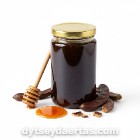
Distinguishing carob blossom honey from syrup
Here, carob honey means honey made by bees visiting carob blossoms. The Dahabi label gives 32 kcal and 7.8 g sugars for a weighed 10 g amount. Increasing that to 20 g gives 64 kcal and 15.6 g sugars.
Read the ingredients on the jar
Some products use the name “carob honey” for a thick syrup made from carob fruit and water. That is different from bee-produced honey. A honey-and-syrup blend also needs its own figures. The name alone is not enough to transfer a honey’s sugar, fat or mineral table to a fruit syrup.
A fuller spoon changes the amount
The 10 g example is a weighed quantity; it does not mean every teaspoon holds 10 g. Weighing honey added to yogurt or bread makes the difference between level and heaped spoonfuls clearer. Natural honey still contains sugars. The CDC advises against honey for babies under 12 months because of the risk of infant botulism.
Limits of the label
The calculation uses 320 kcal from Dahabi’s table per 100 g. Its accompanying 1,360 kJ figure has a small conversion discrepancy. Calcium and iron amounts are unreported; values from another honey have not been added.