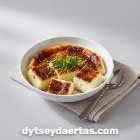
Calories after preparation with milk
Dr. Oetker Kazandibi prepared according to its Turkish recipe provides 151 calories per 100 g. A 150 g portion has 227 calories, 5.4 g protein and 28.5 g sugars. A smaller 75 g slice provides 113 calories and 14.25 g sugars. Weighing the slice is more useful than judging its width.
Making the caramelised base
Cook the 155 g dry mix with 750 ml milk. Once it boils, stir over low heat for a further 3–4 minutes. Transfer to a 26 cm aluminium tray greased with margarine on its base and sides. Move the tray over high heat for 5–10 minutes to brown the bottom. Let it reach room temperature, refrigerate for 2 hours and turn the slices over to serve.
This is different from Pratik Kazandibi, which uses a separate sauce. The 155 g dry packet is not 155 g of finished dessert. Dry powder has 384 calories per 100 g; the prepared panel’s 151 calories per 100 g describe a different stage.
The separate home-style kazandibi recipe uses 155 g for a finished slice. The same number describes dry mix on this packet and cooked pudding with milk and other ingredients in that recipe.
Colour does not measure the sugars
The browned base adds flavour and texture. A darker colour does not remove the serving’s sugar contribution, which is calculated from the prepared weight. Milk and greasing the tray belong to the standard preparation; additional cream, ice cream or sauce contributes separately.
A prepared 150 g slice of Dr. Oetker Tavukgöğsü contains 246 calories and 27 g sugars. Kazandibi at the same weight has about 227 calories and 28.5 g sugars; colour alone cannot identify the lower-sugar choice.
Source: the manufacturer’s Turkish 155 g Kazandibi page. The mix contains sugar, starches and rice flour, with milk added for preparation. Finished tray weight and milk fat class were not inferred. Undeclared fibre and micronutrients remain unknown.