What does a 140 g pot provide?
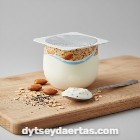
A 140 g pot of Activia Hazelnut–Quinoa–Wheat yogurt provides 109 calories, 4.76 g protein and 3.5 g fiber. It contains 9.8 g total sugars. Half the pot, 70 g, gives 55 calories and 4.9 g sugars. These figures describe the Turkish 140 g product; a newer 150 g Bowl variety has its own label.
How much hazelnut and quinoa is in it?
Lactose-free yogurt is the main ingredient. Hazelnuts and quinoa are each listed at 0.7%, wheat at 0.5% and wheat flakes at 0.3%. That works out to about 0.98 g hazelnuts per pot, rather than a handful. The fiber also comes from added inulin, so it should not all be credited to the small grain portions.
Weigh any nuts or granola you add separately. A 10 g hazelnut topping is much larger than the pot's own hazelnut content and is not included in its nutrition totals. The yogurt alone contributes 170.8 mg calcium; additions change the finished bowl's values. The same 140 g pot of Almond–Chia–Rye contains 4.76 g fiber, compared with 3.5 g in this hazelnut variety.
Does lactose-free mean sugar-free?
No. Beet sugar appears in the ingredients. The declared 7 g sugars per 100 g is total sugar, not a measurement of added sugar alone. Lactose-free yogurt still contains milk proteins. Milk, hazelnut and wheat allergens, together with the package's trace warnings, matter here; this is not a gluten-free product. The distinction between lactose-free and dairy-free explains why the milk-allergy check still matters.
Using the pot as a snack
A single pot makes the quantity easy to track, but its roughly 4.8 g protein does not make it a complete meal by itself. There is no universal daily number of pots: consider the rest of your meals and how hungry you are. Keep it at 0–4 °C and follow the pack's date and instructions after opening.
Label used for the calculation
The supplier panel for the 140 g product declares 78 calories per 100 g. Conflicting salt and sodium entries mean sodium remains unknown. A different formulation on your own pack takes precedence.