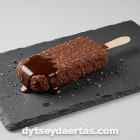
The current 60 g Alaska Frigo dark chocolate bar provides about 191 calories. Beneath the coating is a frozen milky cocoa dessert, so it should not be treated as a solid dark chocolate tablet. Half a bar weighs 30 g and provides about 95 calories.
Dietitian's Tips for Consuming Alaska Frigo Bitter
How much sugar and fat are in a bar?
A 60 g bar supplies 22.44 g carbohydrate, 17.52 g sugars, 9.84 g fat and 2.34 g protein. Saturated fat is 5.52 g and fibre is 1.8 g. Half a bar contains 8.76 g sugars. For a whole pack, use the 60 g calculation instead of the label’s 100 g row.
Compare flavours at equal weight before comparing their actual packs. Dark provides 318 calories per 100 g and caramel 316, so their energy densities are similar. Yet the 47 g caramel bar provides about 149 calories against 191 for the 60 g dark bar. Pack weight explains much of that difference.
The milk-chocolate Alaska Frigo bar at the same 60 g weight contains 18.84 g sugars and 5.46 g saturated fat. Dark contains 17.52 g and 5.52 g respectively; the word “dark” does not mean every value is lower.
Where does the 60.8% cocoa figure apply?
Dark chocolate coating makes up 20% of the product. The minimum 60.8% cocoa statement describes that coating, not the whole bar. A 60 g bar contains 12 g coating. Its filling includes milk ingredients, sweetening ingredients, wheat and hazelnut as well as cocoa.
The dessert contains milk, gluten and hazelnut and may contain pistachio and peanut traces. “Dark” does not mean dairy-free or sugar-free. Store at −18°C and do not refreeze after thawing.
The cocoa-percentage label guide makes the same distinction: a coating percentage alone does not reveal the whole dessert’s sugars or calories. Choose the amount using the panel for the complete 60 g bar.
Source and formulation match
Figures follow the supplier panel for the 60 g bar. Ingredient ratios from the older 360 g multipack have not been mixed into the current formula. Undeclared vitamins and minerals remain unknown; portion calories are rounded.