

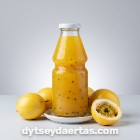
Yellow passion fruit juice: measure the drink you pour
How many calories are in a glass?
Raw yellow passion fruit juice contains 60 kcal per 100 grams, or 90 kcal per weighed 150 grams. USDA’s reference cup weighs 247 g and gives 148 kcal. Household glasses differ in size; 247 g is a mass, not a claim of 247 ml. Zero the scale with the empty glass, then weigh the juice. [1]
Does no added sugar mean zero sugar or calories?
No. The raw juice entry contains 14.25 g sugars per 100 g, giving about 21.38 g in a weighed 150 g. Sugar is already included in carbohydrate. Adding water does not remove the total sugar; it changes the concentration per gram of the mixture. Commercial nectar, syrup and cocktails also need their other ingredients counted.
Which vitamins does it contain, and is it like whole fruit?
A 100 g amount provides 18.2 mg vitamin C, 47 µg RAE vitamin A and 278 mg potassium, with 0.2 g fibre. Juice is not the same fibre source as seed-containing fruit pulp. These are nutrient amounts, not evidence that the drink improves sleep, alters hormones or treats disease.
Is purple juice or passionflower tea the same product?
This calculation describes raw juice from the yellow variety. Purple passion fruit juice has a separate entry, and bottled drinks depend on their labels. Passionflower tea and supplements are not equivalent to fruit juice. When mixing a drink, weigh the juice, water and additions separately rather than applying this one table to the whole mixture. For comparison, see the variety and label distinctions for purple passion fruit juice.
Calculation basis: the historical USDA SR28 entry for the stated edible part and preparation.



