

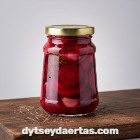
Sweetness and portion size in pickled beetroot
The Berrak Pickled Beetroot 700 g label declares 40 kcal per 100 g. Scaling the label to 50 g provides 20 kcal, 4.5 g carbohydrate and 3.5 g total sugars. When adding it to a salad or serving it alongside a meal, account for the sugar and salt as well as the beetroot flavour.
Amounts are calculated from the 100 g product panel. They are not a separate measurement of beetroot after discarding the liquid or rinsing.
Is sugar added to these pickled beets?
Yes. The inspected product lists beetroot, water, white vinegar, sugar, salt and garlic flavouring. The declared 7 g total sugars per 100 g includes both the beetroot's own sugars and added sugar. The amount added is not separately declared, so the two cannot be split numerically.
For carbohydrate counting, use the total carbohydrate line rather than only sugars. The calculation is 4.5 g carbohydrate for 50 g product or 2.7 g for 30 g. Pickled beetroot should not be treated as plain boiled beetroot or another brand's recipe.
The generic pickled-beet reference describes a different sample including solids and liquid, with 11.05 g sugars per 100 g. Its difference from Berrak’s 7 g label value cannot be attributed to beet variety alone; recipe and the liquid included in the analysis can also differ.
Consider salt when adding it to a salad
A 50 g amount contains 0.85 g salt. In a salad with cheese or olives, several salty ingredients contribute to the total; taste before adding more salt. Using 30 g gives 12 kcal and 0.51 g salt by the label calculation. There is no single correct daily amount for everyone; consider the rest of the meal and any individual salt restriction.
The jar has a net weight of 700 g and a drained weight of 430 g. The label cannot tell you precisely how much salt is removed by discarding the liquid or rinsing the beetroot. The product is pasteurized; being pickled is not proof of a probiotic effect. Follow the instruction to refrigerate after opening.
Berrak cucumber pickle’s 30 g label calculation gives about 4 kcal and 0.9 g salt, compared with 12 kcal and 0.51 g for beet pickle. The lower-calorie choice need not be the lower-salt one.
Nutrition panel note
The actual 700 g package panel declares 40 kcal and 1.7 g salt per 100 g product, equivalent to a calculated 680 mg sodium. No separate analysis of rinsed or drained beetroot is provided. The package takes precedence over conflicting online tables; undeclared fibre and micronutrients remain unknown. See NIH's explanation of probiotics for the distinction.



