

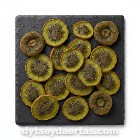
Sweetened dried kiwi: label and portion
Some dried kiwi slices have sugar added during processing. The example used here, Nuts.com Dried Kiwi, is a sweetened product: its 40 g label serving provides 150 calories, and a weighed 20 g portion provides 75. Those figures should not be applied to every dried kiwi product.
Total sugars and added sugars
The 27 g total sugars in a 40 g serving already include 17 g added sugars. Do not add the two numbers together. At 20 g, that becomes approximately 13.5 g total sugars, including 8.5 g added sugars. The same amount has 18.5 g total carbohydrate and 0.5 g fiber.
No-added-sugar dried Bing cherries still contain the fruit’s own sugars. A zero added-sugars declaration does not mean zero total sugars.
Cranberries sweetened with concentrate do not declare a separate added-sugar weight in the reference label. Their total sugars cannot all be called added sugars.
How many slices make a serving?
Slice size and thickness vary, so a handful or a few pieces do not have a dependable fixed weight. Weighing 20 g into a small bowl gives half the label serving. If you mix the slices with yogurt or nuts, consider both the sweetened fruit and the amounts of the other ingredients.
How is it different from unsweetened fruit?
The ingredient list includes kiwi, sugar, citric acid, sodium metabisulfite and Blue 1 and Yellow 5 colors. It contains sulfites, with possible milk and soy contact also noted on the label. Unsweetened and freeze-dried products need their own labels. The vitamin C amount in fresh kiwi cannot be transferred to these sweetened dried slices.
Label basis
The calculations use the 40 g label for Nuts.com Dried Kiwi. Protein and fat are rounded to zero on that label, which does not establish absolute analytical absence. Vitamins A and C are unreported. An iron daily-value percentage alone was not converted into a precise mass.



