

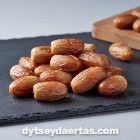
Dietitian's Tips for Consuming Baghdad Date (Zahidi)
Zahidi is a dry to semi-dry date variety also sold as Baghdad dates. Its piece weight should not be assumed to match Medjool or another cultivar. Hadiklaim’s dried-Zahidi reference provides 291 calories per 100 g, about 58 per weighed 20 g of pitted flesh and 87 per 30 g.
How do you calculate three dates?
Remove the pits and weigh the edible flesh of all three together. If the total is 20 g, the calculation gives roughly 58 calories; at 30 g it gives 87. Size and dryness vary, so three pieces alone do not establish a calorie count. The grower’s 8–12 g whole-fruit size range was not treated as pitted edible weight.
A 20 g amount supplies around 14.38 g carbohydrate, 12.53 g total sugars and 0.87 g fibre. Adding a measured 10 g of raw almonds makes a snack of about 116 calories, 2.50 g protein and 2.12 g fibre. Almonds add texture and nutrients; they do not reduce the sugar already present in the dates.
A 20 g pitted amount of Datella Medjoul Medium provides about 64 calories on its own label, versus about 58 for the same weight of the Zahidi reference. Equal grams show the cultivar and source difference; one piece of each is not necessarily an equal portion.
The softer fresh Mazafati comes to about 49 calories for the same 20 g of pitted flesh.
Are dried dates low in sugar?
The reference contains 62.63 g total sugars per 100 g. Sugars naturally present in dried fruit still count towards carbohydrate intake. No added sugar does not make an unlimited portion appropriate. Eating a few dates as a sweet snack and adding a large amount of date paste to a recipe produce different totals.
For weight management, consider the measured portion alongside the other foods in the meal instead of assigning everyone the same daily number of dates. Check packaged fruit for syrups or coatings. Zahidi values should not be applied to date syrup, an unspecified Arabian date or every cultivar.
Remaining source uncertainty
The Hadiklaim Zahidi variety table is a grower’s reference, not an analysis of every harvest. Its sodium line prints “34.00 g”, which is incompatible with the other values; sodium remains unknown rather than being silently changed to milligrams. Minerals or fibre from studies in other regions were not added to the panel. The almond snack example uses a separate USDA raw-almond calculation.



