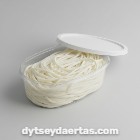
Ekici string cheese: packet weight and protein
The calculation uses Ekici's published label for its 200 g Tel Peynir, with 311 kcal and 24 g protein per 100 grams. A handful of these cheese strands has no fixed weight. Turkish tel cheese, other string cheeses and individually wrapped mozzarella sticks may have different formulations. [1] The 30 g calculation for Bahcivan Cecil cheese uses that product’s own panel; a number of strands cannot be transferred between brands.
Calories in a portion or packet
A weighed 30 g amount gives 93 kcal and 7.2 g protein. For 50 g, the calculation is 156 kcal; the entire 200 g packet provides 622 kcal. Packet size is not a suggested single serving. One or two strands cannot be assigned a reliable calorie figure without their weight. Weigh the amount you set aside rather than borrowing the weight of another brand's cheese stick.
Salt and saturated fat alongside protein
The manufacturer declares 1.9 g salt and 16 g saturated fat per 100 g. A 30 g portion therefore contains 0.57 g salt and 4.8 g saturated fat. Its 228 mg sodium figure is calculated from declared salt. Read these figures alongside protein when comparing cheeses. Calcium, fibre and cholesterol are not declared on the label used here; missing information does not establish a zero value. The salt and sodium calculation for Muratbey lor illustrates a comparison using that cheese’s own label.
The generic Dil cheese reference gives about 0.90 g salt equivalent per 30 g, compared with the 0.57 g declared for the same weight of Ekici Tel Peynir. Separating into strands does not establish an identical salt content.
Using the cheese in breakfast or toast
Serve a measured amount with bread and vegetables, or set it aside before making a toasted sandwich. Butter and other sandwich ingredients need separate calculations. Advice such as “two a day” is unhelpful when a strand has no standard weight. Do not assume this milk product is suitable for a milk allergy. Check the packet for ingredients and storage instructions, and avoid judging quality or personal suitability from calories alone.