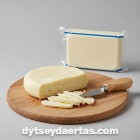
Dietitian's Tips for Consuming Bahçıvan Tongue Cheese
The manufacturer’s 200 g pack of Bahçıvan Dil cheese declares 331 calories per 100 g. A weighed 30 g gives about 99 calories and 40 g about 132. Its pull-apart texture does not mean that every strip or slice weighs the same.
What does a 30 g breakfast portion provide?
At 30 g, the cheese supplies 7.5 g protein, 7.5 g fat, 4.5 g saturated fat and 276 mg calcium, together with 0.66 g salt. Using 40 g in a sandwich raises protein to 10 g and salt to 0.88 g. Bread and other fillings need their own calculation.
Dividing the pack by weight is more useful than relying on an undefined medium slice. One fifth of the 200 g pack is 40 g. The whole pack contains 662 calories and 4.4 g salt; its net weight is not a recommended single-person portion.
At an equal 30 g compared with Bergen Kars gruyere, string cheese provides about 99 kcal and 0.66 g salt, versus 119 kcal and 0.81 g for gruyere. Protein is 7.5 g and 7.95 g respectively; similar protein does not mean identical nutrition.
Is Dil cheese low in salt?
The name and soft texture do not guarantee low salt. The manufacturer declares 2.2 g per 100 g. Include the bread and other foods alongside the cheese when adding up salt in the whole meal. For a cheese comparison, use equal weights: 40 g of the same brand’s current halloumi supplies 1.2 g salt, versus 0.88 g in Dil. The comparison uses the halloumi label before cooking.
Dil, Çeçil and braided cheese are separate products even when their nutrition panels resemble one another. Dil’s ingredients include pasteurised cow’s milk, salt, cheese culture, calcium chloride, rennet and potassium sorbate. A single additive name is not a useful basis for declaring a food “clean” or unhealthy; consider the amount, salt and milk allergen relevant to your use. A declared 0 g sugars does not establish that the cheese is lactose-free.
Pack information used
The calculation follows the 100 g panel on Bahçıvan’s 200 g Dil cheese page. Older 293-calorie values and a retailer’s 320-calorie panel were not averaged into it. Sodium was derived from 2.2 g salt as 880 mg per 100 g. Unreported vitamins, iron and other nutrients remain unknown. Follow the purchased pack’s refrigeration instructions.